

The Marketing Strategy Explained
Real Marketing Strategy: Moving Past the "Burned Business Owner" Trap
Almost every single first conversation I have with a potential new client starts exactly the same way. Before we even talk about their goals, they feel an overwhelming need to explain to me precisely why they do not trust "marketing people."
Usually, the story involves a painful past experience.
- Maybe they hired a smooth-talking agency that went completely radio-silent.
- Maybe they dumped thousands of dollars into local advertising that didn't generate a single phone call.
- Maybe they were promised earth-shattering results by a salesman, only to end up with a empty bank account and a massive disappointment.
And let’s be completely fair: our industry is absolutely flooded with bad apples, scammers, and people who completely misrepresent what they can actually deliver.
But if I am being 100% honest with you, many of these horror stories ultimately come down to one specific thing: an uneducated business decision on the part of the owner.
Because of those past mistakes, the next legitimate marketing professional they speak with has to spend weeks earning back trust that some random amateur destroyed.
The Massive Business Expense Double Standard
Over the years, I have noticed a fascinating double standard among local business owners.
They will willingly write massive checks to invest in new service trucks, heavy machinery, specialized tools, physical office space, employee payroll, and bulk inventory.
They view those things as completely necessary costs of doing business.
But when it comes to marketing—the literal engine responsible for bringing in the customers to pay for all those trucks and employees—they suddenly become extremely resistant to spending a single dime.
Now, to be clear, I am talking about many business owners, not all of them. And hopefully, definitely not you.
But if you are someone who has been burned by a bad marketing experience in the past, you cannot allow that old scar to permanently stop you from growing your business today.
One bad investment years ago does not remove your daily responsibility to make better executive decisions moving forward.
If you want sustainable, predictable growth in today’s hyper-competitive market, you have to move past the status quo.
Stop allowing previous disappointments to dictate your future opportunities. Refusing to market your business properly out of fear, frustration, or past trauma does not protect your company. It limits it.
Education is Your Best Insurance Policy
How do you guarantee you never get ripped off by a marketing company ever again? It’s simple: You educate yourself on how the game is actually played.
When you learn the basic framework of modern visibility, something incredible happens:
- You stop getting tricked by useless tech jargon.
- You start to understand how the lead generation process actually functions.
- Your business decision-making becomes sharp, calculated, and highly strategic.
At the end of the day, your business’s profitability is entirely dictated by your willingness to build and execute a consistent marketing strategy.
You must possess an executive mindset that understands this reality, embraces the investment, and adapts to the market. Let’s look at how to build that strategy the right way
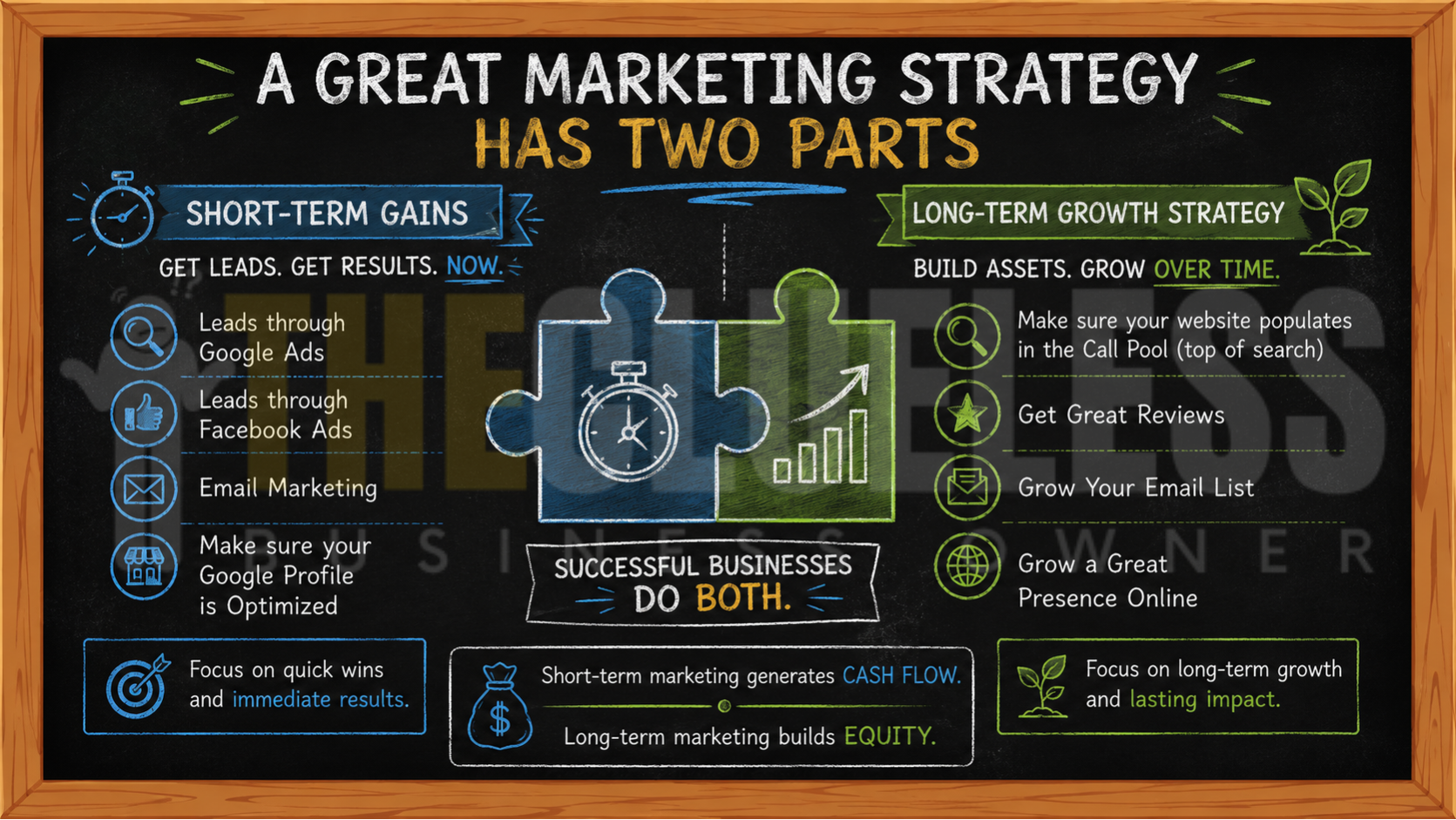
The Two-Part Architecture of a Great Marketing Strategy
A successful, high-performance marketing strategy must always be split into two distinct, deliberate parts:
1) Short-Term Gains (The Immediate Oxygen)
- Google Ads (Capturing high-intent searchers right now)
- Facebook Ads (Building local awareness and target leads)
- Email Marketing (Quickly activating your existing customer base)
- Optimizing your Google Profile (Driving immediate phone calls through reviews)
2) Long-Term Growth (The Permanent Foundation)
- Making sure your website ranks in the Call Pool (Holding the top spot of search/scroll organically)
- Getting great online reviews (Building an unshakeable reputation over time)
- Growing your email list (Owning your direct line of communication to the market)
Marketing efforts that are consistent and have a long-term focus pay your business dividends over time. More importantly, they reinforce the short-term gains you’ve already paid money for through online advertising.
Once you build a great online presence and your customer can find you at the top of the search, coupled with paid ads, your business will experience great growth.
The Inconsistency Trap: Your Ultimate Competitive Advantage
I have been working directly with business owners for the past 10 years, and I have learned a ton! If there is one definitive thing I have learned, it is this: the most powerful thing we can do in our marketing is to be thorough, focused, and consistent.
Executing a thorough, consistent plan will absolutely blow your competitors completely out of the water.
How? Because 80% of small businesses are not consistent at marketing. Their efforts aren't very strategic at all—they are mainly 100% focused on short-term gains with no long-term strategy. They operate reactively instead of proactively.
And here is a massive inside secret: even when it comes to much larger companies, their digital marketing efforts can be just as sloppy! Do not let yourself be intimidated just because you think they are BIG and you are little. Trust me on this!
Leveling the Playing Field: Claiming Your Piece of the Pie
On the internet, the playing field is completely leveled.
Back in the day, when all businesses were just located on physical streets, it was fairly obvious who the bigger guy was. It was easy to see the massive building, the fancy fleet of branded trucks, and all the employee cars parked out front.
But today? We don’t see those physical assets on the internet. A one-man operation with an elite, fast-loading website and an immaculate Google Profile can look just as authoritative—if not more trusted—than a cold corporate enterprise.
Yeah, sure, the big guys have deeper pockets when it comes to raw marketing dollars.
BUT you only need a portion of the search to make your business wildly successful. You do not need the whole thing.
Remember, you don't have 150 employees to feed like some of those giant companies do, and you don't have a massive corporate office space to pay for.
Your skin in the game is a little different. All you need to scale your company and build wealth is your specific piece of that search equity pie!
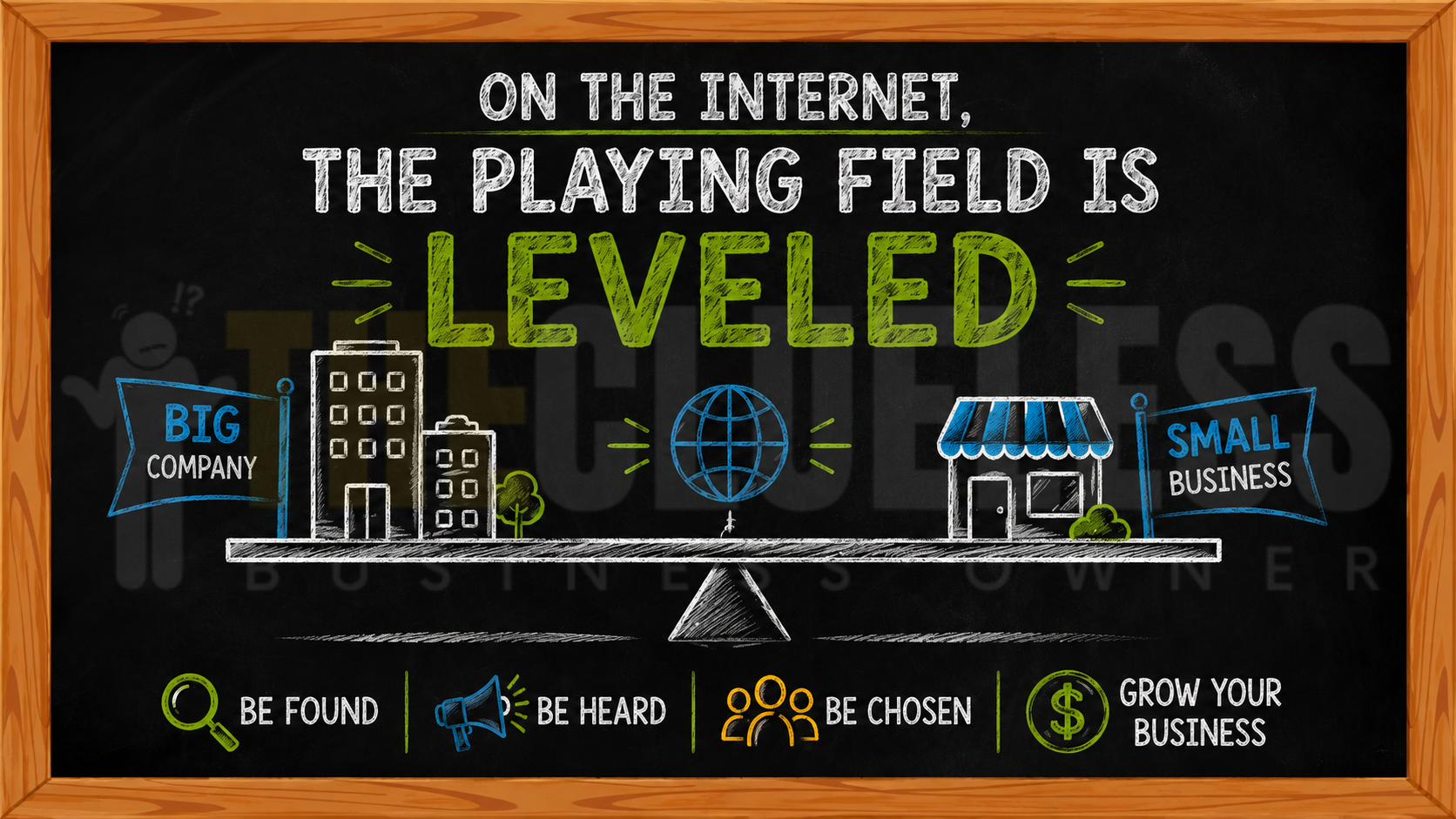
Bigger is an Illusion Online
When a homeowner has a problem, they go online looking for an immediate solution. They look at the options on their screen, make a decision within a matter of seconds, and click.
At first glance, the consumer has absolutely NO idea which business is "bigger."
In the digital world, bigness is an illusion. A company with two trucks can look just as established and trustworthy as a corporate giant with a fleet of fifty.
Because the physical building and the massive overhead are hidden behind the screen, anyone can compete.
Winning the local market isn't about the size of your office; it’s all about your marketing strategy and what you are willing to invest to make sure your business is visible in the Call Pool.
Understanding the Call Pool
The
Call Pool is simply the group of businesses a searcher actually sees on their screen when they look for a product or service online.
If your business isn't appearing in that immediate field of vision, you don't exist to that customer. Shockingly, many established local companies have little to no placement in the Call Pool.
They are completely missing from the top results, and that exact weakness becomes a massive, highly profitable opportunity for their competitors.
In my consulting practice, this is one of the single biggest advantages we identify and leverage to help our clients generate more leads and quickly increase their visibility.
Because the reality is simple: If your business is not showing up where customers are actively searching, another business will capture those calls instead.
The Lack of Visibility Achilles’ Heel
Think about how many great companies in your town are losing potential customers every single day. It isn't because they offer a bad service, and it isn't because their prices are wrong. It is simply because they are practically invisible online.
That lack of visibility is their ultimate Achilles’ heel.
On the flip side, the business owners who take the time to understand how to position themselves directly inside the Call Pool can often gain a major competitive advantage very quickly.
You don't need to buy a massive building or hire a hundred employees to beat the big guys—you just have to out-position them where the customer is looking.
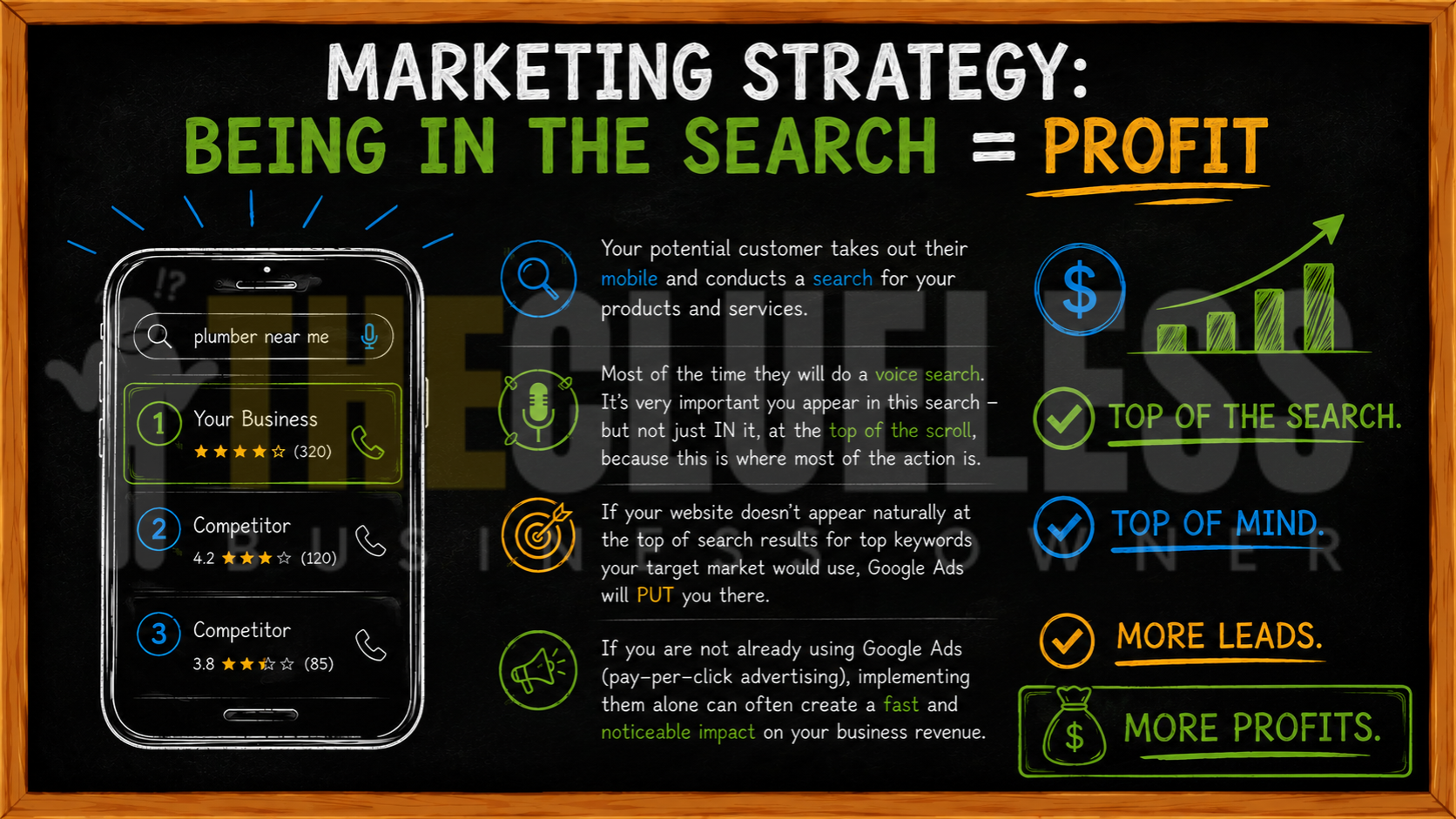
Marketing Strategy: Being in the Search = PROFIT
Think about how a modern customer finds a business. They pull out their phone, type or voice-search for a service, and look at the screen.
If you want to grow your company, it is absolutely critical that you show up in those results—and not just anywhere, but at the very top of the scroll. That is where all the action is.
If you run a service business where you know people are actively looking for what you do every day, your absolute tools of choice should be Google Ads (formerly AdWords) and Local Services Ads (LSAs).
If your website doesn’t naturally appear at the top of the search results yet, Google Ads will literally PUT you there instantly. To win in today's market, you have to develop a pay-to-play mentality.
If you aren't already using Google Ads, turning them on can create a fast, highly noticeable jump in your monthly revenue. This is where a massive chunk of your short-term growth comes from.
Why? Because Google Ads place your business directly in front of highly motivated consumers who already have an urgent need. They aren't browsing; they have intent, they have their wallets out, and they are looking for a solution right now.
Facebook Advertising: Staying Top-of-Mind
While Google captures the immediate, urgent searches, we also use Facebook advertising to build fast awareness throughout your entire local selling area.
Even if a homeowner isn't ready to hire an electrician or a plumber today, seeing your business repeatedly on their feed builds deep familiarity and trust over time.
This is incredibly important because not every customer makes a split-second buying decision. Many people like to research, compare options, read reviews, and think things over before making a final choice.
That consideration process matters. To capture those cautious buyers, we use Facebook retargeting campaigns.
Google Ads = Captures the immediate, hot leads looking to hire someone today.
Facebook Ads = Keeps you in front of past website visitors so they don't forget you.
Retargeting is a simple system that displays your ads specifically to people who have already visited your website and are already familiar with your name. It keeps your business top-of-mind while they are making their decision.
Because at the end of the day, consumers don't always choose the first business they see. They choose the business they remember.
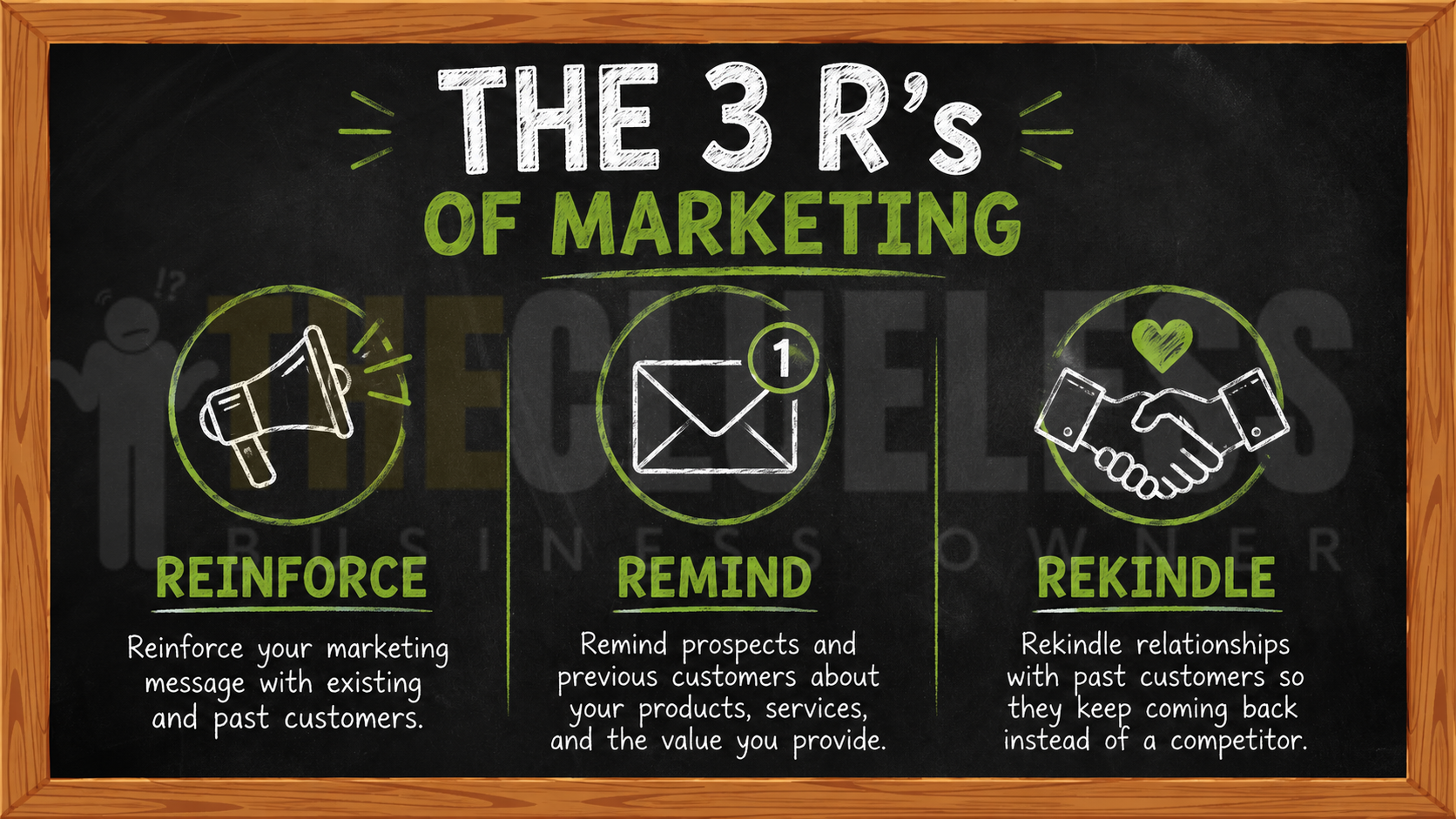
Marketing Strategy: The 3 R's of Marketing
My ultimate goal is to help you divide your marketing strategy into two clean categories: long-term growth and short-term gain. However, there are certain areas where these two approaches overlap and work together perfectly.
One of the absolute greatest assets you can ever build in your business is your customer and prospect list. That is why continually growing that database should always be a non-negotiable priority.
Building a massive, high-quality list takes time, which is why it falls under long-term growth. But at the exact same time, that list can generate immediate, short-term revenue when you leverage it correctly.
This is one of the most overlooked areas in local business marketing. Enormous amounts of potential revenue are left on the table every single day simply because owners fail to properly communicate with the list they already have.
To make this easy to implement, I break it down into a proprietary framework I call
The 3 R’s of Marketing:
- Reinforce your marketing message with existing and past customers so your brand stays strong.
- Remind prospects and previous customers about your products, services, and the unique value your business provides.
- Rekindle relationships with past customers so they continue returning to your business instead of drifting over to a competitor.
Staying highly visible to your current and past customers is incredibly smart because you have already invested the time, energy, and money to bring those people into your world in the first place.
This brings us to a massive short-term and long-term weapon:
remarketing.
What Is Remarketing?
Remarketing (also frequently called retargeting) is a digital advertising strategy that allows you to continue marketing specifically to people who have already interacted with your business in some way.
This includes people who have:
- Visited your website or viewed specific service pages.
- Clicked on your active Google or Facebook ads.
- Signed up for a special local offer or joined your email newsletter.
- Already submitted a form to become a warm lead or a paying customer.
Remarketing gives you a direct opportunity to reconnect with people who showed real interest in your business but didn't immediately pull the trigger.
Maybe they visited your site but got distracted before calling. Maybe they contacted you for a quote but weren't quite ready to buy yet. Maybe they are still actively comparing options or waiting until their next payday.
The way you deploy remarketing depends heavily on your specific business model and your average invoice size:
High-Ticket Services (e.g., $6,000 Window Replacement)
Requires a longer consideration process. Consumers price-shop, delay, and research.
Remarketing keeps you visible so they don't forget you during the weeks it takes them to decide.
Recurring/Lower-Ticket Services (e.g., Lawn Care, Handyman Work)
Driven by high purchase frequency.
Remarketing ensures they remember your name the next time they need a hand, and allows you to cross-sell additional services they don't even know you offer.
The beautiful part? The vast majority of your local competitors are completely failing to do this consistently.
Three Highly Effective Remarketing Strategies
1. Email Marketing
Yes, email marketing is still an absolute powerhouse. I use email marketing in my own consulting practice every single day, and it consistently generates massive, highly profitable sales for my clients.
We use email to promote seasonal offers, introduce new services, and share educational content. Educational emails are incredibly valuable because they naturally build deep trust, position you as the undisputed local authority, and keep your phone number top-of-mind.
2. Facebook List Matching
Facebook allows us to upload your existing customer and lead lists directly into their advertising platform securely. This means you can display highly targeted, custom ads specifically to people who already know, like, and trust your brand. This is a lethal tool for running special promotions, booking out seasonal offers, and securing repeat business.
3. Google Retargeting
Google retargeting allows you to place subtle tracking scripts on your website so you can follow up with past visitors across the internet. You can also upload your direct customer lists into Google’s ad platform. This strategy ensures your business remains entirely visible while a consumer is actively researching solutions, drastically increasing the odds that they circle back to buy from you instead of someone else.
Creating a Marketing Strategy: Your Website
One of the single most valuable financial assets your company can ever own is a website that ranks at the top of the search results for the exact keywords your local market uses.
This is the bedrock of your online presence—a website that firmly positions your business directly inside the Call Pool.
When your website is highly visible to active searchers, it acts like a tireless, 24/7 employee that pays your business back year after year in a steady stream of incoming leads, phone calls, and booked revenue.
Unfortunately, a massive percentage of local business owners still view their website as nothing more than an expensive, digital business card. They pay to get it built, throw it up on the internet, and completely forget about it.
That mindset is a costly mistake.
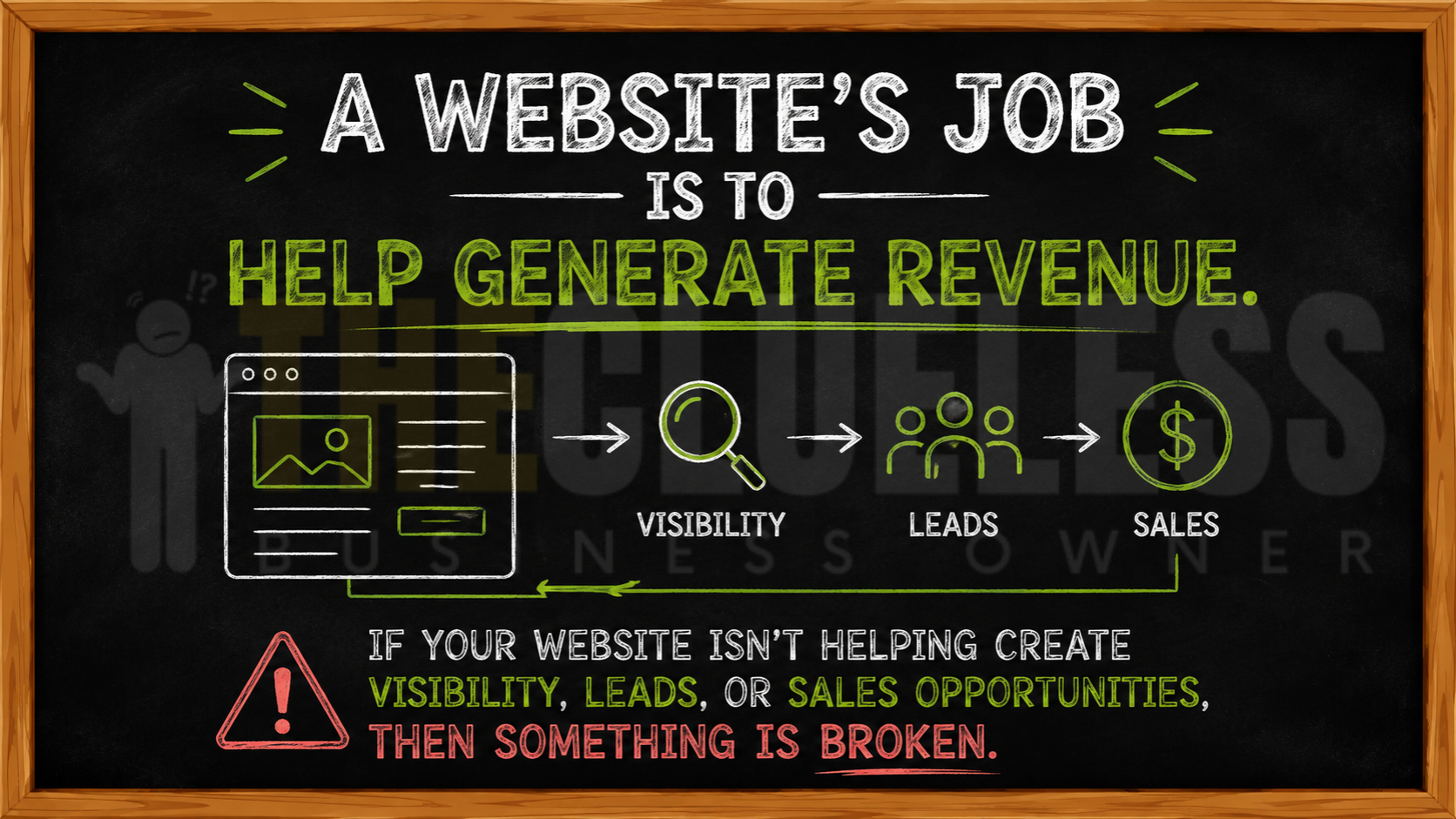
A website’s primary job is to generate revenue for your business. If your site is not actively creating visibility, attracting leads, or opening up new sales opportunities, then your system is broken. Your website should function as an aggressive growth tool—not a passive digital brochure.
The Digital Version of Compounded Interest
Website visibility is a core pillar of your long-term marketing strategy because building dominant search rankings takes time. Clean search engine optimization (SEO), local content creation, map authority, and visibility growth do not happen overnight.
However, the long-term payoff is enormous.
Paid Ads = Like renting space. The second you stop paying, the leads vanish.
Organic SEO = Like owning land. Once you rank well, it keeps paying you back.
Once your website begins ranking at the top for the highest-value searches in your local market, it will continue producing inbound phone calls and jobs for years with just standard maintenance and strategy.
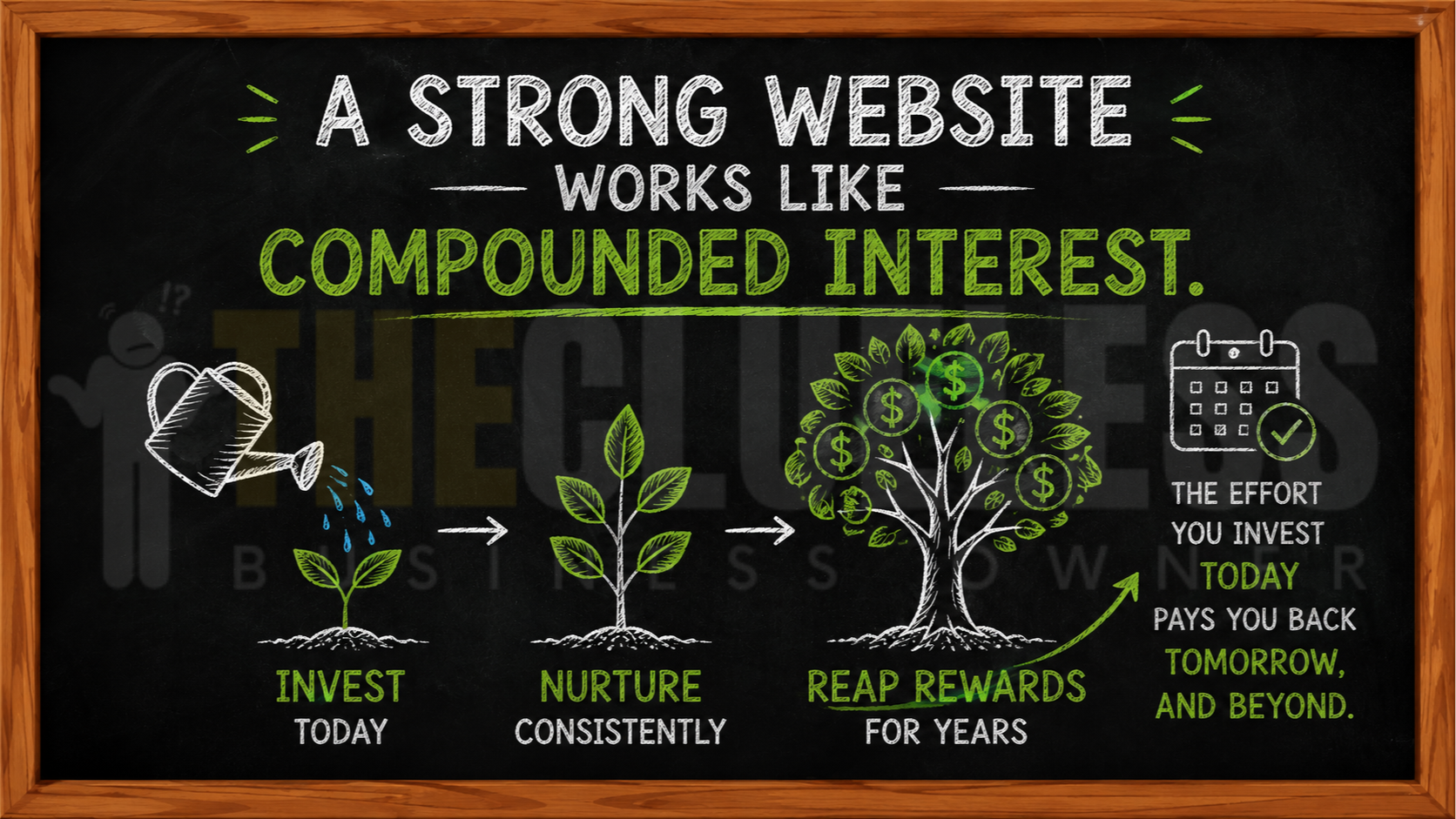
In many ways, a high-ranking website works exactly like compounded interest. The time, effort, and resources you invest into your search visibility today will compound and continue paying your business dividends long into the future.
Capitalizing on Your Competitors' Misunderstanding
This is one of the single biggest opportunities you have to completely separate your company from the local competition.
The truth is, even in a world where consumers search on their phones for nearly every single service they need, the vast majority of your competitors still do not fully understand how digital visibility works.
They fail to prioritize their online rankings, they neglect their websites, and that misunderstanding is costing them tens of thousands of dollars in lost opportunities every single year.
The business owners who step up, understand the math behind visibility, and invest in building their search presence consistently are the ones who capture a permanent competitive advantage.
Use their lack of awareness as your launchpad to gain massive traction in your market before they ever wake up and realize what hit them.
Marketing Strategy: The Google Business Profile Goldmine
Another incredibly vital piece of your long-term growth engine (which also packs a massive short-term punch) is your Google Business Profile (formerly Google My Business) and a relentless, hard focus on getting great customer reviews.
To win at local search, you have to leverage your profile properly and take full advantage of all the bells and whistles that come along with it.
To give you a specific example, I have a client who owns a small home-service business that grosses a little over a million dollars a year.
A few years ago, we decided to implement a highly focused lead generation strategy: we were going to put a massive, aggressive focus on collecting high-quality, five-star reviews from every single happy customer.
The result? Those consistent reviews pushed his Google Business Profile straight to the number-one spot in the local map search. That massive jump in visibility instantly drove up his rankings, which exploded his online clicks. And those clicks turned directly into paying customers.
The Power of the Proof: 3 Months of Real Data
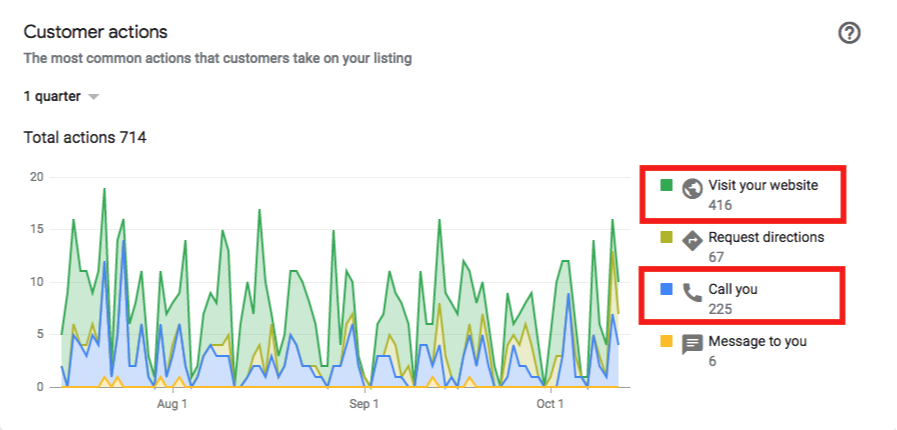
The numbers below show a direct representation of what happened over just a 3-month period on this client's Google
Business dashboard after we optimized his profile and automated his review process:
- Website Visits: 416 direct clicks to the website
- Phone Calls: 225 direct click-to-calls from the map profile
- Year-Over-Year Growth: A massive 400% increase in map performance.
By simply stepping up our internal efforts to collect great reviews,
this business brought in an additional $200,000 in clean sales revenue that year alone.
A properly optimized Google Business Profile acts like a money machine, bringing huge profits into a small business year after year. It can do the exact same thing for your company.
Do not ignore this absolute goldmine. Leverage it, dominate your local map search, and start generating predictable sales for your business.
Lead Generation: Cold, Warm, and Hot Leads
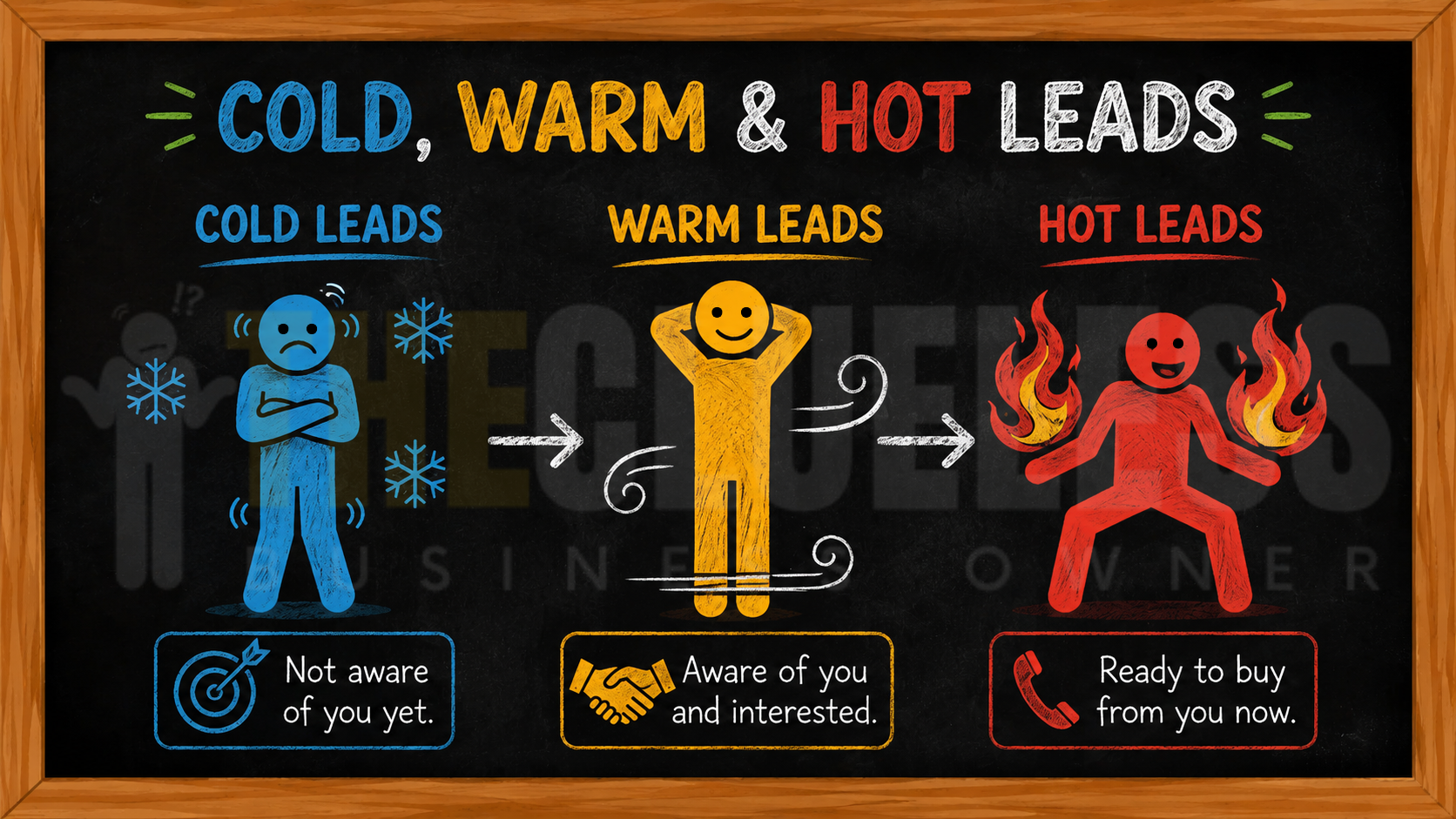
Before we dive deeper into your marketing plan, we need to break down the three different types of leads your business will interact with every day. In the marketing world, you will often hear these referred to as different parts of a "funnel"—but let's just look at them in terms of temperature.
1. Cold Leads (Top of Funnel)
A cold lead is someone who is learning about your business for the absolute first time. They might have just found your name through a raw Google search, stumbled onto a Facebook ad, or seen your truck drive by. At this stage, they are totally unfamiliar with you. There is zero trust, zero familiarity, and zero relationship built with your brand yet.
2. Warm Leads (Middle of Funnel)
A warm lead is someone who has already interacted with your business in some way but hasn't handed over their credit card yet.
- They visited your website to check out your services.
- They filled out a form to request a free quote.
- They called your shop to ask a quick question.
- They clicked on one of your digital ads or joined your email list.
These people already know you exist. Because the ice is broken, they are far more valuable—and dramatically cheaper to reach—than completely cold leads.
3. Hot Leads (Bottom of Funnel)
A hot lead is usually an existing or past customer. It can also be a warm lead who has reached out to you multiple times and has finally made the definitive decision that they are ready to buy. If someone has already trusted you enough to buy from you once, there is a massive probability they will buy from you again in the future—as long as you stay visible and maintain the relationship.
The Massive Financial Gap: $43 vs. Under $1
This temperature scale is exactly why remarketing is such a powerful financial weapon. Running ads to warm and hot leads on platforms like Google and Facebook is dramatically less expensive than advertising to completely cold audiences.
Let's look at the real-world numbers from my own marketing practice:
Lead Type: Cold Lead (Window Replacement Search)
Platform:Google Ads
Cost-Per- Click:
$22 to $43+ per click
(In big cities or competitive areas, it can go even higher)
Lead Type: Warm/Hot Lead (Past Window Replacement Website Visitor)
Platform: Google Remarketing
Cost-Per- Click: Under $1.00
That massive difference in advertising cost is exactly why remarketing is a non-negotiable part of the strategy I build for my clients.
Every single one of my accounts has a specific portion of their budget permanently locked into remarketing campaigns on Google, Facebook, and YouTube.
Automated Follow-Up: Shifting the Homeowner's Decision
Let's look at how this plays out for a home window replacement company.
A homeowner clicks a Google Ad, lands on your website, and requests a free estimate. Your team sends over the quote, but the homeowner doesn't book the job right away.
- Maybe they are price-shopping other local companies.
- Maybe they need a few weeks to figure out the financing.
- Maybe life just got crazy busy and they forgot about it.
A few days later, they are scrolling through Facebook or watching a video on YouTube, and boom—your company's ad pops up on their screen.
That repeated visibility reinforces your message and keeps your name top-of-mind. Even better, it naturally shortens your sales cycle.
High-ticket services naturally require a longer decision-making process because people are spending thousands of dollars. They need time to think, compare estimates, plan financially, or talk it over with their spouse.
A massive percentage of local home-service jobs are won simply through consistent follow-up—and an even bigger percentage are completely lost because businesses fail to stay visible after that first estimate.
Remarketing acts like a tireless, automated follow-up system.
Even if a customer gets distracted or delays the project, your ads keep gently reminding them that you are ready when they are. Over time, that familiarity builds deep trust, until one day they finally say: "Okay, let's call them back and get this scheduled."
The best part? Most of your local competitors are still completely clueless about how to use remarketing effectively.
That means you have a massive opportunity to step in, implement it correctly, and scoop up the jobs they are leaving behind.
Keep Learning

Growth Mindset
Give a group of people the same business to run and access to all the same resources. Some will succeed and some will fail. What is the deciding factor? Their mindset. This is what divides.